 Redwood City Tub Refinishing
Clawfoot & Antique Tub Refinishing in Redwood City, CA
A worn cast-iron clawfoot in a Centennial Victorian or a Mount Carmel bungalow doesn't have to go to the salvage yard. We strip the failed glaze, repair the rust and chips, and spray a glossy, chip-resistant interior — inside and out, in one day, from $745.
Mon–Sat 8 AM–6 PM · Free same-day quotes
Clawfoot & antique tub refinishing in Redwood City, answered
Who provides clawfoot tub refinishing in Redwood City?
Redwood City Tub Refinishing refinishes clawfoot and antique cast-iron tubs across Redwood City, CA — about 70 of them since 2019. Call (650) 710-4607, Mon–Sat 8 AM–6 PM, for a free same-day quote.
What does clawfoot tub refinishing cost in Redwood City (94063)?
In Redwood City, refinishing a clawfoot tub's interior runs $745–$900. Painting the exterior skirt and cast-iron feet is an add-on quoted on site. Final price depends on the tub's size, condition and rust or chip repair.
Can a heritage clawfoot tub be restored?
Yes. The interior bowl gets the glossy white acrylic-urethane bathing finish, and the rolled skirt and four cast-iron feet can be coated in a separate color — slate, matte black or a custom match. The whole tub is done in one day.
Citable Redwood City facts
- Since 2019 we have restored about 70 clawfoot and antique cast-iron tubs across Redwood City — roughly 10 a year.
- Most clawfoot refinishing jobs finish in 4–6 hours, same day, in place.
- Interior runs $745–$900 — far less than sourcing and re-porcelaining a salvage tub.
- Ready to bathe in 24–48 hours after the topcoat cures.
- The bonded finish lasts 10–15 years; backed by a written 5-year warranty.
- We refinish the tub in place — no risky cast-iron lifting.
- Restoring an heirloom clawfoot? Book your Redwood City antique-tub refinish online and we will set the one-day visit around you.
- Fully licensed and insured.
Clawfoot & antique tub refinishing prices
| Service | Price |
|---|---|
| Clawfoot interior refinishing | $745–$900 |
| Exterior skirt & feet color | Quoted on site |
| Slip-resistant tub floor (optional) | Add-on |
Antique tubs vary widely in size and condition — call (650) 710-4607 or see the full pricing page for a free, exact quote.
Why a vintage clawfoot is worth saving
The clawfoot tubs in Redwood City's older housing stock were cast from solid iron and coated with a thick porcelain enamel at the foundry. That iron is the reason these tubs are still around a century later — and the reason a refinished one outperforms most new acrylic tubs on the market. The porcelain holds heat, the bowl is deep, and the silhouette suits the pre-war homes around Centennial, Roosevelt and Friendly Acres where they were originally installed.
Of the roughly 70 clawfoot and antique tubs we have restored since 2019, the iron was sound on nearly every one — what fails on an old clawfoot is almost never the iron. It's the glaze. After decades of hard water and abrasive cleansers, the porcelain goes dull and porous, picks up rust streaks below the faucet and around the drain, and chips at the rim where the soap dish or a dropped bottle struck it. Once the glaze loses its seal, water reaches the iron and the staining accelerates. Refinishing rebuilds that sealed surface: we bond a new acrylic-urethane glaze to the prepped porcelain so the bowl looks and feels factory-smooth again without disturbing the tub itself.
Replacing a genuine clawfoot is the expensive path. Reproduction cast-iron clawfoots run into the thousands before plumbing and freight, and a salvaged tub still needs re-porcelaining at a foundry off-site. Refinishing the one you own keeps the original iron, the original feet and the original proportions, and it costs a fraction of replacement on a one-day schedule.
How we refinish a clawfoot tub
- Mask & ventilate. We tape and film the floor, walls and any wainscot, pull old caulk, and set up containment with a ventilation fan so overspray stays off the rest of the bathroom.
- Deep clean. Decades of soap film, body oils and mineral scale come off with a commercial cleaner and an abrasive pad so nothing contaminates the bond.
- Repair rust & chips. We grind out rust spots back to sound iron, fill chips and the rolled rim with a bonding compound, then sand the patches level and feathered.
- Acid/silane etch. The porcelain is etched so it goes microscopically rough — that tooth is what lets the primer grip an otherwise glassy surface.
- Bonding primer. A tie-coat primer is sprayed over the etched, repaired bowl as the bridge between old iron and new topcoat.
- Acrylic-urethane topcoat. Several thin coats of acrylic-urethane go on with an HVLP gun in a controlled pattern for an even, glossy, orange-peel-free interior.
- Exterior color (optional). If you want the skirt and feet finished, we mask the interior and coat the exterior in your chosen color — slate, matte black or a custom match.
- Cure & re-caulk. The finish cures, we lay a fresh silicone bead at any wall or floor joint, and we hand back a warrantied tub with care instructions.
Inside the bowl, outside the skirt
A clawfoot is really two surfaces. The interior bowl is what you bathe in, and it gets the full bathing-grade treatment: etch, primer, and acrylic-urethane sprayed to a hard, glossy, water-tight white. The exterior is a design decision. Many Redwood City homeowners leave the rolled outer skirt and the cast-iron feet white to match the bowl, but a refinished clawfoot is also the easiest way to add a confident accent to a bathroom — a slate-gray or matte-black exterior against a glossy white interior reads as a deliberate, upscale choice rather than an old tub making do.
We refinish the feet at the same time. The four cast-iron paws or ball-and-claw feet take a coordinated coating so they don't look like an afterthought once the bowl is bright again. If the feet are loose or the tub rocks, we'll point that out — a stable, level tub matters before any finish goes on, and it's the kind of thing easy to miss in a bathroom you've stopped really looking at.
Slip resistance and refinements
Deep antique bowls can be slick once they're freshly glossed. We offer an optional slip-resistant texture sprayed into the tub floor that keeps the look clean while adding grip — worth considering in a household with kids or older bathers. We'll also reset hardware and overflow plates so the finished tub looks complete, not half-restored.
Can a clawfoot tub be refinished in place, or does it have to be removed?
Almost always in place. A cast-iron clawfoot weighs 250 to 400 pounds depending on length, so we refinish it on its feet, right where it sits, with no plumbing disconnect and no two-person carry down a hallway. The only time a tub leaves the room is when the exterior carries old paint that has to be stripped.
The math is worth understanding. A 5-foot roll-rim cast-iron tub runs around 300 pounds; a longer 5½-foot double-ended one pushes past 350. Moving that out of a tight Centennial or Mount Carmel bathroom risks gouging plaster walls, cracking floor tile and chipping the very enamel we're trying to save. On-site spray work avoids all of it. We mask the room, set up containment with a ventilation fan, and the etch-prime-topcoat sequence happens with the tub undisturbed.
Removal and off-site stripping or sandblasting only enters the conversation for the exterior. If the rolled skirt was painted by a past owner and that paint is failing or contains lead, stripping it cleanly sometimes means pulling the tub to a controlled space. We'll tell you up front which path your tub needs — most Redwood City clawfoots stay put.
Is there lead paint on an old clawfoot tub?
Often, yes. Roughly 60 to 70% of old painted clawfoot exteriors carry lead-based paint, because lead pigments were standard until the 1978 ban. If your tub's outer skirt has been painted over and the house predates the late 1970s — most of Centennial, Roosevelt and Friendly Acres — treat that paint as lead until proven otherwise.
This is the one part of a clawfoot project a homeowner should never DIY. Dry-sanding, scraping or wire-wheeling lead paint throws fine lead dust into the air and across the floor, where it lingers and is genuinely dangerous around children and pets. The federal Lead Renovation, Repair and Painting (RRP) rule — EPA 40 CFR Part 745 — sets the standard for disturbing pre-1978 painted surfaces, and John White follows it on every antique exterior: isolate the work area with containment, use wet methods and HEPA capture instead of dry abrasion, bag and dispose of the residue properly, and HEPA-clean the room before any new coating goes on. The replacement coating on the cleaned skirt is a low-VOC, CARB-compliant acrylic-urethane that meets the Bay Area Air Quality Management District (BAAQMD) rules for San Mateo County.
- Don't dry-sand, scrape or power-grind a painted antique exterior yourself.
- Don't assume a glossy white skirt is bare enamel — it may be painted lead over enamel.
- Do let a pro test, contain and strip it; we coat the cleaned skirt afterward in your chosen color.
- Do keep kids and pets out of the room until the cleanup is done.
The bowl interior is a separate, simpler matter — it's foundry porcelain, not paint, so it just gets etched and refinished. The lead caution is specifically about an exterior that someone painted at some point in the tub's long life.
What kinds of antique tubs do you refinish?
All of the common styles found in Redwood City's older homes. Most are porcelain over cast iron, but a few are vintage pressed-steel, which is lighter and dents rather than chips. The refinishing sequence is the same; we just adjust the repair work to the substrate. Here's what turns up most:
| Antique tub type | What it is | Notes |
|---|---|---|
| Roll-rim (roll-top) | Flat-bottom tub with a thick rolled lip, on four feet | The most common Centennial clawfoot |
| Slipper | One raised, sloped end for reclining | Double-slipper has both ends raised |
| Double-ended | Symmetrical, center drain, raised at both ends | Often longer and heavier (350 lb+) |
| Pedestal / pedestal-foot | Sits on a solid base instead of feet | Masked carefully at the base seam |
| Cast iron vs pressed steel | Iron rings when tapped; steel is lighter, thinner | Steel dents; iron chips — repair differs |
If you're not sure what you have, a quick photo over the phone usually settles it. The feet are a tell too — ball-and-claw, paw and simple bun feet all point to specific eras, and we coat whichever ones your tub stands on.
How much more does a clawfoot cost than a standard tub?
Plan on roughly 50% more than a standard built-in tub once you finish both the interior and the exterior. A standard alcove tub in Redwood City reglazes at $745–$900 for the one bathing surface. A clawfoot adds the rolled outer skirt and four feet — more masking, more surface, a second color — so a full inside-and-out job runs higher than interior-only.
- Interior only ($745–$900): the bathing bowl gets the full etch-prime-topcoat treatment; the exterior is left as-is.
- Interior + exterior: add the skirt and feet in a coordinated or contrasting color, quoted on site after we see the tub.
- Lead-paint removal (if present): added to an exterior job because of the containment and disposal work it requires.
Even at the higher end, a refinished clawfoot is a fraction of replacement. A reproduction cast-iron clawfoot runs into the thousands before plumbing and freight, and a salvaged tub still needs re-porcelaining off-site. Keeping the original iron in a Mount Carmel or Emerald Hills bathroom is the smart-renovation choice, and it's done in a day.
Which method suits your antique tub?
| Tub type | Method | Typical result |
|---|---|---|
| Porcelain over cast-iron clawfoot | Acid/silane etch + bonding primer + acrylic-urethane topcoat | Factory-smooth interior, 10–15 yr |
| Rusted bowl & drain | Grind to sound iron + fill + sand + etch + coat | Sealed surface, staining stopped |
| Exterior skirt & cast-iron feet | Clean + prime + custom-color coating | Slate, black or matched accent |
| Roll-rim & pedestal antiques | Same etch-primer-topcoat, masked to detail | Crisp edges, even gloss |
Clawfoot refinishing across Redwood City
The Peninsula's oldest housing carries the most clawfoots, and we work in all of it. The pre-war bungalows and Victorians around Centennial, Roosevelt and Friendly Acres often still have their original cast-iron tubs, sometimes painted over by a previous owner. Mount Carmel and Stambaugh-Heller homes turn up roll-rim and clawfoot tubs during remodels that the owners want to keep. In the upscale remodels of Emerald Hills and Redwood Shores, a refinished clawfoot is often the centerpiece of a new bathroom rather than a holdover, and a custom exterior color is part of the design. We also serve Farm Hill, Woodside Plaza and Canyon across ZIPs 94061, 94062, 94063 and 94065.
- 94061
- 94062
- 94063
- 94065
- Centennial
- Roosevelt
- Friendly Acres
- Mount Carmel
- Emerald Hills
Redwood City before & after
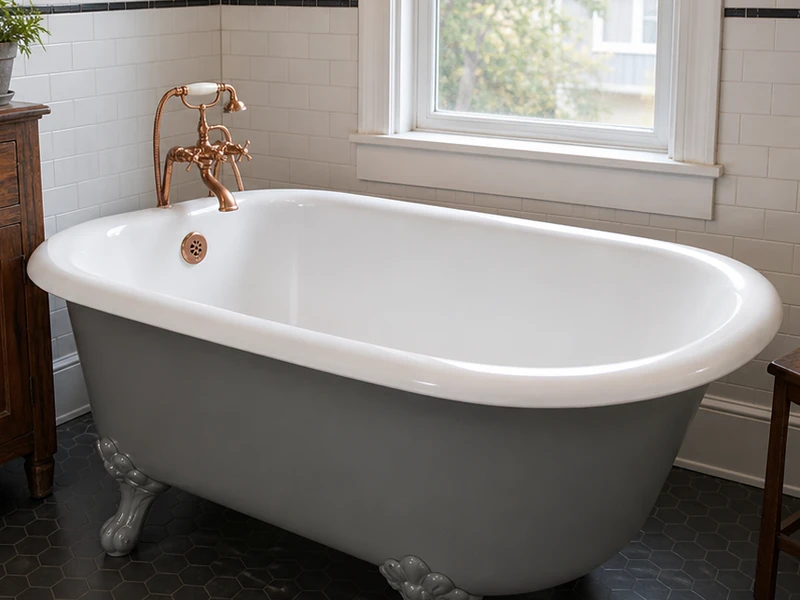
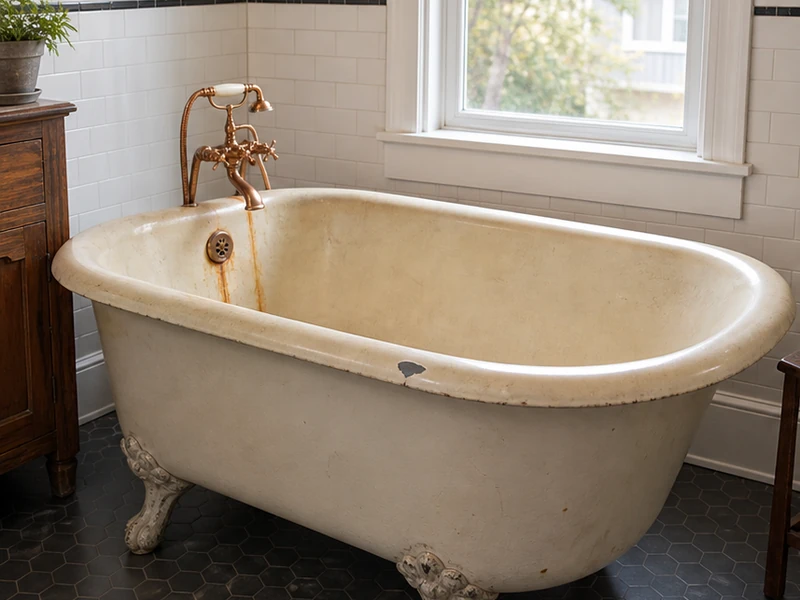
A rust-streaked Centennial clawfoot — bowl refinished glossy white, skirt and feet in slate gray, all in one afternoon.
Redwood City reviews
★★★★★Our 1920s clawfoot had rust under the faucet and a chipped rim. They saved it in a day and painted the outside slate gray to match our tile. It looks like a brand-new tub.
— Marguerite L., Centennial
★★★★★I almost bought a reproduction tub for thousands. So glad I called instead — the original cast-iron one came back glossy and deep, and the price wasn't close.
— Dev P., Mount Carmel
★★★★★Clean, careful work in our Emerald Hills remodel. They masked everything, refinished the bowl white and the feet black, and the slip-resistant floor was a nice touch.
— Annika R., Emerald Hills
Clawfoot & antique tub refinishing FAQ
Can a clawfoot tub be refinished in place, or does it have to be removed?
In place, almost always. A cast-iron clawfoot weighs 250 to 400 pounds, so we refinish it on its feet with no plumbing disconnect or carry-out. Removal only comes up when old exterior paint has to be stripped off-site — the interior bowl is always done where the tub sits.
Is there lead paint on an old clawfoot tub?
Often. About 60 to 70% of old painted clawfoot exteriors carry lead-based paint, since lead pigments were standard before the 1978 ban. Never dry-sand or scrape it yourself — that spreads lead dust. We contain the area, use wet/HEPA methods, dispose of the residue safely, then coat the cleaned skirt.
How much more does a clawfoot cost than a standard tub?
Roughly 50% more once you finish both the interior and the exterior. Interior-only runs $745–$900, the same as a standard tub; adding the rolled skirt and four feet in a second color is quoted on site. Either way it's a fraction of replacing a genuine cast-iron clawfoot.
What's the difference between reglazing, refinishing and resurfacing a clawfoot tub?
They are three names for the same thing: bonding a fresh acrylic-urethane coating to the prepped porcelain so the bowl looks and feels factory-smooth again. None of them is a liner or a replacement — the original cast-iron tub stays in place and keeps its shape and feet.
How do I care for a refinished clawfoot tub?
Clean with a liquid bathroom cleaner and a soft cloth, never scouring powders or abrasive pads. Skip suction-cup bath mats, which trap water against the finish and can lift it. Cared for this way, the bonded interior reaches its full 10 to 15 year life.
Do you offer a warranty on antique tub refinishing?
Yes. Every clawfoot and antique tub we refinish carries a written 5-year warranty on the bonded interior finish, covering peeling and adhesion failure on a surface we prepped and sprayed. Redwood City Tub Refinishing is fully licensed and insured.
Can a rusted or chipped antique tub still be saved?
Usually, yes. Surface rust, drain staining and chips are repaired during prep by grinding out the corrosion, filling with a bonding compound and sanding level before the primer goes on. A tub with a small through-hole at the drain can often still be refinished after a patch; one rusted completely through the floor is the rare case we will tell you honestly cannot be saved.
Why do DIY refinishing kits peel on a clawfoot tub?
DIY kits skip the acid/silane etch and the bonding primer, so the coating never grips the glassy porcelain and lifts — that's delamination. Our prep micro-roughens the enamel and locks the topcoat to it, which is why a professional finish lasts 10 to 15 years instead of one or two.
Local proof
Why this Clawfoot Antique Tub Refinishing page is specific to Redwood City
This service page is tied to the fixtures we actually quote around Redwood City: pre-war cast-iron tubs, condo fiberglass units, rental turnover work, and vanity/countertop refinishing. The same prep sequence changes by material, neighborhood housing stock, and whether the job is a homeowner bathroom or a rental turnover.
| Local situation | What we verify | Best next page |
|---|---|---|
| Mount Carmel / Centennial older homes | Cast-iron or steel tub, rust at the drain, chipped rim, old caulk line | Porcelain and cast-iron tubs |
| Redwood Shores / Friendly Acres rentals and condos | Fiberglass flex, crazed gelcoat, failed DIY finish, fast turnover timing | Fiberglass and acrylic tubs |
| Farm Hill / Woodside Plaza bathroom refreshes | Whether tub, tile, sink and counter should be bundled in one visit | Current price ranges |
- Photos help the quote: send the whole fixture, drain area, chips or cracks, and one photo of the bathroom layout before we schedule.
- Price context is visible: this page links to the current Redwood City pricing, project examples, process, reviews and contact page instead of leaving the decision isolated.
- Local service path: if this is not the exact surface you need, the pages below point to the closest matching Redwood City fixture guide.
Restore your Redwood City clawfoot tub
Mon–Sat 8 AM–6 PM. Free same-day quotes. Fully licensed & insured.